Sunday, September 9, 2012

A flight from Chennai


Last July I flew from Sacramento to Long Beach, California to visit my brother before catching a flight  to Delhi.  After a one-hour ride, we landed, taxied to the terminal, and the seat belt sign switched off.  A half dozen passengers leisurely stood to retrieve their bags from overhead while the rest of us remained seated, waiting for the door to open. When it did, we exited by rows. I grabbed my things when my turn came and followed the folks ahead of me to the terminal. All very normal; just another summer day in California.

Last week, I wrapped up a workshop in Chennai and flew home to Pune. After a little over an hour flight, the plane landed, taxied to the terminal, stopped, and before the seat belt sign switched off, fifteen of the passengers where on their feet opening the luggage bins.  Moments later, the aisle was packed, shoulder to shoulder, with passengers surging forward, anxiously awaiting the opening of the plane’s door.

I was in a middle seat so I simply waited; the aisle was full but I could feel the fellow by the window next to me getting antsy.  The door was still closed yet he could hardly contain himself and began to crawl over me to force his way into the crowd.  I blocked him with my arm and simply said with a smile, “Let’s all wait for our turn. OK?”  He sheepishly sat back down.  As the seats ahead emptied, we were able to stand and go.  My seatmate, right behind me, hurried to the baggage carousel, there to await the eventual arrival of his luggage.   

I’ve seen this scene played out again and again and never stop wondering, “Why?”  Where does the compulsion to hurry and push from one spot to the next come from, especially when one must simply wait some more at the next place.  There is a rush to get off the plane only to stand and wait for a bus to the terminal, jostling to get on the bus and then a rush to the baggage claim to wait some more.  I could understand if one had a need to catch a connecting flight, maybe meet someone waiting outside or if by pushing ahead, something useful is accomplished, but ninety nine times out a hundred, there is no good reason.  It’s just a habit and makes no sense to me.

I was at the Newark airport a few years ago awaiting a flight to Delhi.  Arriving early, I had already watched flights leave for Copenhagen, Frankfurt and Istanbul.  As these flights were called, passengers assembled and boarded in an orderly fashion.  Before my flight, airport personnel came with stanchions and cordoning for crowd management, knowing Indians’ tendency to push to the front and ignore boarding instructions.

I’ve pondered over this for years because it relates to driving, behavior in queues, getting on and off the Metro or being anywhere groups gather.  Indians want to get ahead and maybe this accounts for their success when abroad. They are willing to work very hard and are highly intelligent, but they also seem, to my eye, stressed and anxious.  Maybe it's because they are forced to wait for so many things in life--government services, traffic, the repairman who always comes late, the fellow who says he will "definitely be there" but never is. Of course, maybe none of this is true and I'm just seeing things through my laid-back Californian eyes.  

I suspect Indians have learned that waiting one’s turn is not a good strategy when resources are tight and when others are willing to push you aside to get their share (and yours) first.   With so many, many people, standing politely aside simply isn’t a reasonable option. “Yield” signs on the highways don’t exist; they are a foreign concept.  I’ve asked my Indian friends to explain this to me but have yet to hear a satisfying answer. They just laugh and maybe that’s the best approach.  

Saturday, June 16, 2012

Mango Season

June is when the monsoon arrives along the Kerala coast, kids get vacation breaks, families head for the hills or their ancestral villages, and the mangos are ripe in Pune. The "King of Fruit" dominates the fruit stands for an all-too-short month or two from late May into July with dozens of varieties, shapes and sizes to please every palate. India just wouldn't be the same without them.

Every region has its favorite variety and there is much debate about which is best. Pune is in the heart of "mango country" with the variety of choice here being the Afus or Alfonso. At our ashram we have about a dozen trees evenly split between these and the local Pyree variety. Much like avacados, mangos don't grow true from seed and the best varieties are grafted onto local root stock, making it common to find a wide array of ungrafted, less favored trees in the countryside. Although not as tasty, they are fine for cooking, jams and pickle.

Last week we harvested this year's crop and now have hundreds of mangos ripening in beds of straw with one of our offices now serving as a ripening room. As you can imagine, mango is on the menu every day. Laxmi has been preparing a delicious mango soup for lunch. She cooks the mangos in a pot of mango juice, adding spices and seasoning to give the final product, served hot, both a sweet and savory flavor. Anand, our cook has a delightful way of cutting off the top of each mango and extracting the seed, leaving the most of the fruit inside to be eaten with a spoon. It's easy to eat three or four of these at a sitting.

Indians have a love affair with mangos and I can see why. At the market, you will easily find half a dozen varieties on display, the varieties changing as the season progresses. It's heresy to contest the supremecy of the Afus, but I've grown fond of some of the other varieties too. I especially like the Kesar, a small, green fruit with an orange flesh similar to the Alphonso. The big, yellow mangos like the Badami, which are usually cheaper, are juicy but not as flavorful, in my opinion, but they are very good for shakes and smoothies. The same goes for the Totapuri. The variety typically found in American markets comes from Latin America and is OK but its flavor is less intense than the mangos found in India. The fruit here is sweeter here and more aromatic, though I've heard a few Westerners say they can be too sweet. Imagine.

I remember some years ago flying into Delhi from Mumbai in late May. As I was awaiting my luggage, I watched box after box of mangos moving along the bbaggage carousel. Half those flying were bringing home mangos for friends and family. Last Wednesday I brought bags of them to Mumbai for Sangha friends at a Gita class. It's just what you do.

I love mangos but I'd like to mention a couple of other wonderful fruits that ripen about now. One is the chickoo, a fruit very similar in shape and color to the kiwi but with a brown flesh that I can best describe as tasting something like a combination of a date and a pear. I really like them although Sadhana Devi doesn't. There is no accounting for taste. Chickoo shakes are fantastic and you can get a really tasty chickoo ice cream at "Naturals", arguably the best ice cream chain in the world. They make, on site, all natural ingredient ice cream, using fruits in season. Really! I had jalum berry ice cream the last time I stopped by one of their shops. Some of the shops will even pack their tubs, for an extra charge, in dry ice so the ice cream won't melt by the time you get it home. As far as I know, Naturals only has shops in Maharashtra but I predict it won't be long before they are countrywide.

Another fruit now in season is the lichi. This is a red, round, spikey fruit about one inch in diameter. The flesh is similar in texture to a peeled grape but the taste is unique. Again, I like them but others don't. I think the slippery texture of the flesh puts some people off. Oh well, to each his own. I mentioned jamun berries as an ice cream flavor but they can also be eaten fresh though the taste is a bit astringent. We have a couple of these trees at the community and when made into a cold jamun-ade, they are fantastic. And, let me tell you about the grapes--some of the very best grapes are found here, much better than in the USA.

 Two other fruits which some rave about but leave me unmoved are the sitaphal and the jackfruit. Sitaphals are also known as custard apples and they have a pleasant, very mild taste. The problem with them is that they are a bit of a hassle to eat with too many seeds. As for jackfruit, we have a huge tree at the Pune community giving dozens of immense fruits, some weighing almost twenty pounds. The fruit is sickly sweet with a very unique flavor. It's a love or hate thing with jackfruit. Our cooks fix it into all sorts of dishes and I like it better that way. In fact, some say it can be used as a vegetarian substitute for beef because it looks just like it when cooked.

Soon the mango season will pass and we'll have to wait another year for their return. In Pune we are lucky because of the great variety of fresh produce grown locally but it's not like in America where you can get imports throughout the year. In India, fruits and vegetables are available by season, which perhaps makes them more appreciated when their time comes.

 Happy mango season.

Saturday, January 7, 2012

A Community in the Making

I include below a short photo essay by Maitreyi Cooper of building progress at our community in the countryside outside of Pune, India. Nayaswami Maitreyi and husband Michael are devotees from the UK, who left their families to live in Ananda's Kriya Yogashram, last September. Michael has taken on the role of Maintenance Manager for the community's varied projects, incuding overseeing the building of the new temple. Maitreyi's duties are also diverse, ranging from housekeeping, community nursing, healing, and writing blogs and ashram event promotion. Maitreyi is also a spiritual author. About two dozen flats are under construction and should ready by April or May.


As future residents, Michael and I have keenly watched the progression of the building of the residential flats since the groundwork began last March.


We cannot pretend that there have been many times of frustration at deadlines being missed. We have had to learn that, in India, work goes at a pace not seen or accepted in the West. We have had to evaluate, in our minds, the real mission of being here in India, which is to fulfil Master’s dream, and not to be hung up on the building of our home. Home is where the heart is, after all!


The build is now moving on a pace. We have watched the flats tentatively, rising brick by brick. The site now looks like a small village has sprung from the hillside as the dwellings cling elegantly to the steep slopes of the valley. A community in the making!


Buildings, of course, do not make a community, but the graceful design that has incorporated the ideals of community living will make it easier for the residents to bond and forge the friendships that are so vital for community survival. The residences will all face on to an ample communal area which will allow for meditation gardens, Yoga pavilion, children’s play area, or whatever we, the residents, would like to fill the space. This has yet to be decided.
It is going to be so wonderful having neighbours who share the same ideals as Michael and I, who we know will be always happy to give a helping hand when needed. It will be exciting to be Uncle and Aunty to all the children and to know what it is to have an extended family.
We are hoping to move into our new home by the end of April, this year. What a joyous, and monumental occasion that will be, and we invite all who are able to come to bless our new home.


Jai Guru!
God bless
Nayaswami Maitreyi and Michael

Thursday, December 8, 2011

FDI in Retail: Is Walmart Coming?

Every foreigner residing in India discovers things don’t work the same here as they do back home, especially if “home” is America or Europe. You have to learn a new way of navigating the tasks taken for granted elsewhere: where to buy groceries or any of the things needed to furnish your home, how to get around, how to hire someone to fix things or find the basics needed to do the job yourself, how to set up telephone service and what to do when it doesn't work. For the new expat, it’s all a big hassle but also part of the adventure of living in a new country, East or West.

I asked an Indian friend who lived in the US for twenty years what he missed most about America and he answered, “Home Depot.” I laughed but after thinking about it, I saw his point. “Do it yourself” types like me are not the norm here where homeowners typically call an electrician
to change a light bulb. I often find myself stumped not because I don’t know how to fix something but because I don’t have the right materials, can't find the proper tools and getting either is such a tremendous hassle. I believe anything can be bought in India but finding it easily it near impossible, at least for a foreigner. My solution in Pune, early on when I was new there and trying to get things built at our community, was to hire one fellow whose job was simply to find things for me in the market districts and then lead me to them. I turned a blind eye to the fact he would then go back to the store owner and get a kick back for bringing me in.
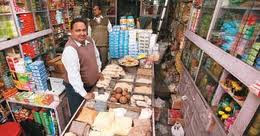
In India, big, multi-brand retail outlets like you find in the West are rare and where they do exist, they are nothing of the scale you would find in the United States. The entire Croma store, a very nice electronics and home applieance outlet near our ashram, is a fraction of the size of any Sears store at an American mall. And just so you understand, even Croma-type stores are not common. We have one close to where I live because our area of Gurgaon is “up-scale” enough to warrant it. In India, shops are typically small and locally owned, often specializing in a narrow line of products with limited selection. There was one shop in Pune I liked that sold only nuts and bolts, but not screws. If you needed a special bolt of any size or style, he probably had it, but getting to his shop demanded a special trip. If I wanted a selection of screws beyond the most basic, I’d go to the screw shop; for a good screwdriver, a special tool shop. So it went for most everything. If you have time and you know your way around, it can be a fun throw-back to the way things used to be in America long ago or still found in small towns. That was a time when you knew your local shop keeper and had time for tea and a chat, when services were provided by people you knew and where customers were greeted by the owner of the store. A part of me misses that, but if you lack time or local knowledge, it’s exasperating.

I mention all of the above because there is a national debate raging here about whether India should allow foreign, multi-brand retail outlets into the Indian market. This can be summed up with one word—Walmart. For now, foreign companies are not allowed to start multi-brand retail
stores in India but some in government would like to ease that restriction so that foreign companies can have a 51% ownership stake in such enterprises. The proposal has unleashed an uproar of hot debate and political maneuvers. For now, it looks like the proposal will be shelved because of the fierce opposition but my guess is that it's only a matter of time before the issue resurfaces. Will India follow the lead of most other majore Asian economies (China, Indonesia, Malaysia) who have welcomed the “big boys” into the neighborhood or will it go its own way.

A lot is at stake in the issue, whether you support or oppose the government's decision. Those against FDI (Foreign Direct Investment) in Retail represent a powerful constituency of small shop (known as kirana stores) owners and the middlemen who supply them. The retail industry is the second largest contributor, after agriculture, to the national economy with countless small shops a feature of the urban landscape. They fear supermarkets and large retail outlets will drive them out of business and completely change the commercial landscape, destroying their livelihoods and replacing them with an army of drone salesboys marching to the tune of Big Brother Walmart. The infrastructure of middlemen, traders and central markets (mandis) could be at risk and India's cultural identity might wither, or so they claim. Populists have threatened to set fire to the first such stores that dare come into their neighborhoods. Others see the “hidden hand” of neo-colonialism once again subverting the land. “The British came to India as traders two hundred years ago and look what happened. Do we want to do it again?” “Do we want to go the way of the West?”

Economists and mobile consumers are on the other side of the argument. Big retail represents
modernity. I'd put farmers as being if favor too but, as usual, they are unorganized and remain silent, letting others claim they speak for their interests. Proponents of economic liberalization say FDI in Retail will bring much needed efficiency to supply chains, a reduction in consumer costs, raise farm income, and increase selection. The arguments about jobs are complex. If the economy expands as predicted, there will be more jobs in the new sectors but those in the old could decrease. It's good to remember that a “job” and a “livelihood” are not the same.

A couple of significant points are more difficult for the average citizen to understand. Multinationals such as Tesco, Carrefour and Walmart are attractive becauese they bring in huge
amounts of capital to invest in infrastructure such as efficient distribution systems, trucking, cold storage for fresh produce, supply networks and all the other things that are behind the scenes. With interest rates rising in India, local firms simply don't have the clout to do this on their own. The law would mandate a percentage of products be locally sourced and, considering the low cost of Indian labor, I would expect Indian manufacturers to benefit, similar to what has happened in China and Indonesia after their markets opened. Secondly, and perhaps of greater long term impact, Indian companies are eager to partner with the big multinationals to learn their systems and adopt their technology. Companies such as Walmart have cutting edge distribution networks and expertise second to none.

My opinion is that large, multi-brand retail stores are inevitable because of their economic efficiencies but there is little doubt, in my mind, that they will also be revolutionary. They will bring change. Is that good or bad? That's where the problem lies; they will upset the status quo. India must decide. The question, to my mind, is not if large retail comes to
India but when. It seems to me just a matter of timing. Indian companies can already engage in large retail if they have the will and resources to do so. Only foreign owned firms are prohibited. I expect local comglomerates will slowly expand their operations to create Indian versions of Walmart, Costco and Home Depot. Already Reliance Industries has opened grocery chains in many big cities but it will just take much, much longer for domestic companies to equal what Walmart could do in a short time. Can India afford to sit on the sidelines. (It should be noted that multi-brand outlets must also receive permission from state governments to operate. Some states prohibit even Indian companies from opening large, multi-brand stores.)

I'm reminded of when I visited India in 1995 and most of the cars where old-style, dumpy Ambassadors that hadn't changed much since the British left India in the late '40's. Foreign automobile firms weren't allowed into the country. When foreign investment was allowed a few years later, everything changed, car ownership exploded, pollution decreased, prices dropped, selection increased and almost everyone junked their Ambassadors except for government officials who can still be seen cruising around town, flags flying on the fenders of the old stand-bys.

I should mention that foreign owned "single-brand retail" is permitted even though multi-brand is not. That is why you will see a Levi's or Gap store in the local mall. All of the products in
those stores are sold under the one brand. The Levi store cannot sell Lee jeans or Wranglers. The rules for ownership now allow 100% ownership of these stores by foreign firms, making it likely a big IKEA store or something like it will soon pop up in Delhi. Walmart has been allowed, in partnership with an Indian firm, to set up a few wholesale outlets in strategic cities to supply the local kirana stores and seem to be popular, although local firms accuse them of selling to retail customers on the sly.

One final consideration is a worrying phenomena I've mentioned before (The Price of Onions). Inflationary pressure is pushing food costs higher at a pace faster than in other sectors of the economy. This seriously affects the poor because they must spend a high percentage of their income (50%-75%) on food. While India modernizes right and left in the cites, agriculture lags behind because of inefficiencies, out-dated regulations, lack of infrastructure and entrenched interests. Something needs to change. Whether the answer is foreign investment or some sort of domestic initiative remains to be seen but for India's sake, I hope it addresses the problem conscoiously rather than tempting fate by waiting. Alas, I suspect nothing much will happen.

Friday, July 1, 2011

A Flood of Books

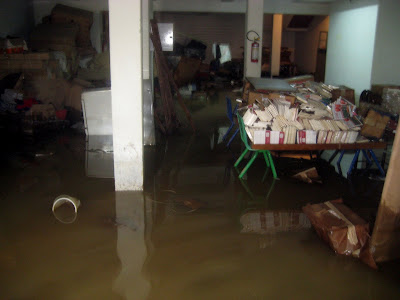
The monsoon reached Delhi last Sunday with a drenching three hour downpour. The dry earth soaked it up as fast it came down and two days later it rained again. On Wednesday Priti from the Dihika School phoned to tell us two feet of water was in her basement and our Publications Department's books were getting soaked. Grabbing all hands available--cook, cleaner, guard, maintenance and our driver--Sangeeta and I hurried over to the school to assess the damage. What a mess!

The front gate was blocked by a huge, knee-deep puddle in front of the house. Wading through, we came out of the water at her front steps and immediately
knew we had a big problem because wet boxes were being brought up from the basement. I rolled up my pants and went down where I found boxes literally floating in water slightly above my knees. The level had been even higher but it was beginning to recede. The photos accompanying this post are from the next day by which time the water had gone down to a depth of about six inches.

We hired extra labor and immediately directed our efforts toward bringing all dry boxes up to ground level. We then separated boxes completely soaked from those that were only partially so and returned the next day with a truck and to move all the dry boxes to Guru Kripa (Swamiji's house).

I mentioned in a previous letter how we had moved the books to the Dihika basement from the Ananda Center to make space for our temple renovation. It seemed like a good spot because there was lots of space, it was well ventilated and not far away. That it might flood had never occurred to us, and the reason it did is very reflective of what's happening in Gurgaon and other places in India under heavy development pressure.

The Dihika School flooded because it sits next to a natural drainage channel (a nullah) that was filled over the last year with excavated construction soil from neighborhood projects. A large community clubhouse was recently built on the other side of the nullah and some of the soil ccould have come from there. What had historically been a watercourse is now a raised flat space blocking upstream water and leaving it nowhere to go when it rains. One of my first thoughts was to hire a JCB (backhoe) to dig a channel through the fill to prevent future lakes but I was told this can't be done because the locals who control the property won't allow anyone to touch it.

Priti lives on the edge of a housing development created by DLF (Delhi Land and Finance), possibly the largest development company in India. The neighboring plot's ownership is disputed but probably belongs to the historic village that existed here before DLF came on the scene. The village panchayat (governing council) won't allow anything be done on their parcel, is at odds with DLF, and probably cares little about their problems. Who knows if tthey allowed the land to be filled intentionally to increase its value?

This story can be retold throughout Gurgaon and India. Whenever it rains, lakes form on the roadways because planning and infastructure can't keep pace with developmwent, natural channels are filled to
create building lots, there is little effective regulation and what government oversight does exist is easily corrupted as land values skyrocket. Gurgaon's plight is a regional joke but no one seems to know what to do about it because things are changing so fast and so much money is at stake. I suspect, after enough damage is done, pressure will be brought to bear on the various parties to force a solution but it will take time. In the meanwhile, it will be interesting to see what happens as this year's monsoon progresses.

Although our Publications Department suffered a serious blow, it's been wonderful to see people rally to help. Have you noticed how adversity often brings out a noble spirit? We estimate at least half our inventory is gone, amounting to a financial blow of many, many thousands of dollars, maybe even tens of thousands by the time we get an accurate count. We'll see which book titles were most affected and then find out the cost of reprinting those we most need.

In some strange way, I feel there is a hidden blessing in this. I know it sounds strange to say that but I suspect good things will come from this if it taken in the right spirit. Who knows what fresh energy will flow? It'll be a challenge I'm sure but our local Sangha will help us and Publications will soon be strong on its feet getting Master's teaching out to devotees in India again. We'll be telling those of you who live in India more about how you can help in the weeks ahead.

Tomorrow and in the coming days, we'll also decide what to do with the wet books and how we can help Priti clean up her school. She too has suffered a loss and is left with a huge challenge because this is the last week of summer break and classes begin again on Monday. As the saying goes, "When it rains, it pours."

We'll post news on our local website www.anandagurgaon.org to keep you abreast of developments.

For photos, go to: https://picasaweb.google.com/jayahelin/BooksFloodedAtDihikaSchool